

Almost every month another report lands in my inbox examining AI adoption in the workplace.
The findings are rarely surprising.
Employees aren’t using AI as much as expected. Many lack confidence. They don’t have enough time to experiment. Leadership wants greater return on investment, but productivity gains remain inconsistent. Organisations continue to invest heavily in AI platforms and licences, yet adoption across teams is often fragmented and uneven.
The worrying part isn’t the findings.
It’s that we’ve been reading remarkably similar reports for the last two years.
Despite billions being invested in AI technology, many organisations are still struggling with the human side of transformation.
The question we should be asking is no longer, “Why aren’t employees using AI?”
It’s, “Why do we keep expecting different results from the same approach?”
AI adoption is a people challenge, not a technology challenge
Most organisations have approached AI implementation in a logical way. They select the right technology, establish governance, deliver training, communicate best practice and encourage employees to explore how AI can support their work.
These are all important foundations.
However, adoption doesn’t happen simply because technology is available.
It happens when people feel confident enough to change established ways of working.
That confidence is built through regular support, coaching, experimentation and seeing practical examples from colleagues facing similar challenges.
One-off training sessions and online learning platforms rarely create lasting behavioural change on their own.
People naturally revert to familiar habits when deadlines, customers and day-to-day pressures compete for their attention.
The missing ingredient: enablement at scale
Many organisations underestimate the scale of change management required for AI adoption.
Rolling out Microsoft Copilot, Google Gemini or another AI platform is relatively straightforward.
Helping thousands of employees integrate those tools into their daily work is something entirely different.
The organisations making the greatest progress recognise that AI enablement isn’t an IT project.
It’s an organisational capability.
It requires people who can work directly with business functions, understand their processes, identify opportunities and help teams build confidence over time.
In many ways, AI adoption resembles previous digital transformation programmes.
Success didn’t come from simply installing new software.
It came from having people on the ground helping others embrace new ways of working.
Is it time for a new role?
As AI becomes embedded across every business function, perhaps organisations should consider creating a new capability altogether.
Imagine an AI Enablement Consultant or AI Workforce Adoption Consultant.
Rather than sitting within a central technology team, these professionals would work alongside departments, helping employees identify practical use cases, improve prompts, remove barriers, measure adoption and continuously improve outcomes.
They wouldn’t replace technical experts.
They would complement them by focusing entirely on workforce adoption.
This could also present an exciting opportunity for early careers talent.
With the right structured training and ongoing mentoring, a new generation of AI professionals could become specialists in driving behavioural change, helping organisations maximise the value of their AI investments while building highly sought-after digital skills.
Leaders have an opportunity
Many executives now recognise that AI will fundamentally reshape the workplace.
However, success won’t be measured by how many licences an organisation purchases.
It will be measured by how effectively its people use them.
That requires investment in culture, leadership, enablement and capability just as much as technology.
The organisations that succeed will create environments where experimentation is encouraged, learning is continuous and employees feel supported rather than judged as they adapt to new ways of working.
Leaders should also recognise that adoption isn’t a one-off milestone.
AI models, tools and capabilities are evolving almost weekly. Workforce enablement therefore needs to become an ongoing business capability rather than a fixed implementation project.
The organisations that move first will move fastest
History tells us that organisations embracing technological change early often create lasting competitive advantage.
AI is unlikely to be any different.
The technology itself is becoming increasingly accessible.
The differentiator will be how quickly organisations help their people use it effectively.
Perhaps that’s why we continue to see the same reports highlighting the same challenges.
We’re investing heavily in the technology but, in many cases, not enough in the people who ultimately determine whether it delivers value.
The next phase of AI transformation won’t be won by the organisations with the biggest AI budget.
It will be won by those that build the strongest AI-enabled workforce.
And perhaps that’s the conversation we should all be having.
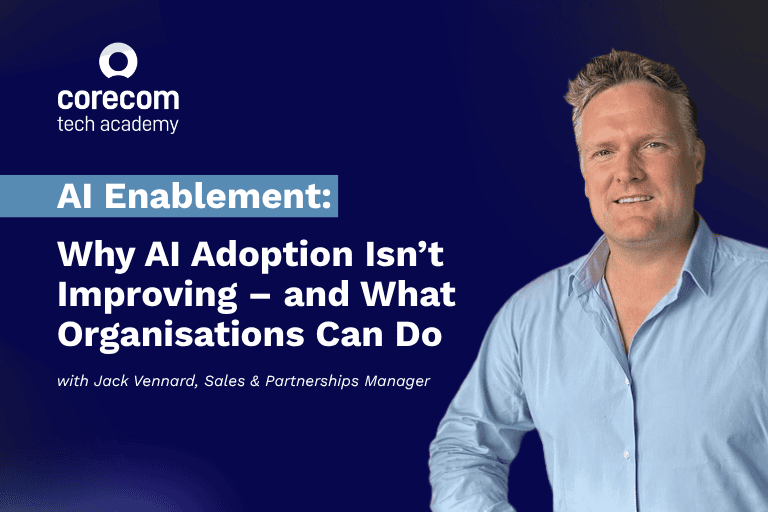
These insights were written and provided by Sales and Partnerships Manager at Corecom Tech Academy, Jack Vennard. To discuss how we can support your business goals, get in touch!
Ready to drive real business results?
Contact Corecom Tech Academy today to explore our tailored training programmes!