

What Is Autism?
Autism refers to a range of developmental differences that changes how individuals experience and interact with the world. These can often relate to areas such as:
- Social interaction and communication
- Verbal and non-verbal expression
- Understanding social cues
- Repetitive or structured behaviours
Autistic individuals bring an incredible, unique set of strengths and perspectives, though they may sometimes experience differences in social communication and interaction. Despite this, countless individuals thrive when supported in the right environment, along with:
- Having an exceptional attention to detail
- Excelling at repetitive tasks, such as coding and analytics
- Are loyal employees with low rates of turnover
An untapped talent pool?
The tech talent shortage is a continuing challenge. Skills in data analytics, cyber security, artificial intelligence and programming, for example, are particularly scarce. The neurodiverse population, specifically autistic individuals, represents an untapped talent pool who may have the skills to help fill the tech talent gap.
Candidates who people usually identify as not being ‘the right cultural fit’ or those whose communication skills aren’t ‘up to scratch’, may be disregarded in an interview, due to a general lack of education and awareness around neurodiversity.
How can Businesses create a more Inclusive Environment for Autistic Employees?
There are a variety of ways that employers can support autistic colleagues. The initiatives undertaken should be tailored to both the individual and the organisation.
Here are 7 tips to create a more inclusive culture for autistic individuals and to tap into the strengths that they bring to the workplace:
- Generate awareness
From the outset, employers should gain knowledge of what autism is and how this looks in the workplace. Communicate why this aligns with your company’s values, such as being more inclusive by;
- Facilitating more comprehensive recruitment and reporting processes
- Improving communication skills
- Encouraging innovation
To understand the mission, training and development in these areas is vital for both teams and managers.
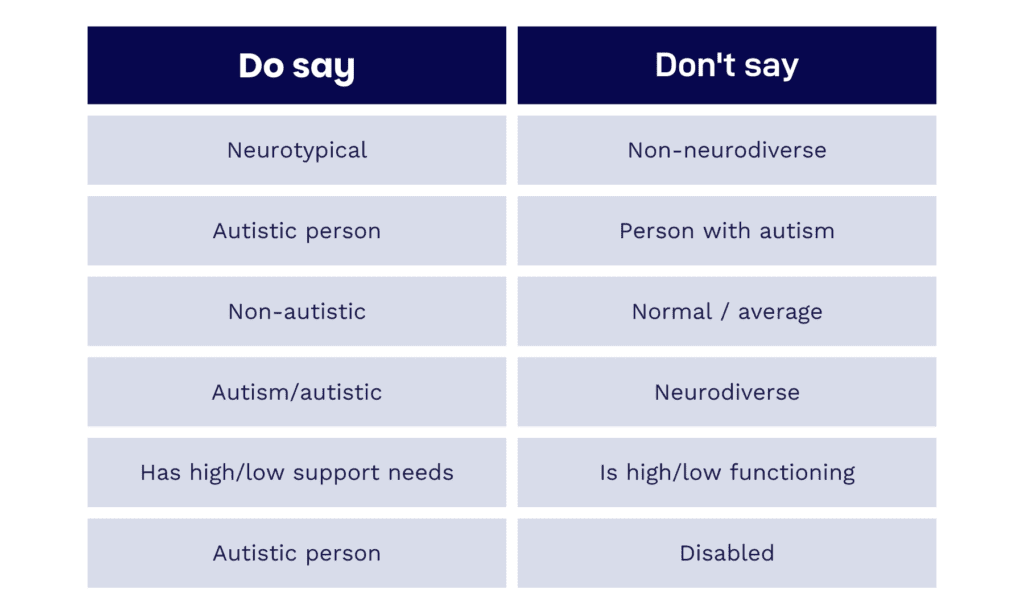
- Use the correct terminology
There have been a variety of terms and phrases used to describe autism, but recently there has been a change in understanding, and positive developments in how we should discuss autism and those affected.
Different people will describe themselves in a range of ways, so it is advised that you ask the person what their preference is.
- Re-think your job adverts
Many autistic people may not apply for a job, even if they are qualified, because they may read job descriptions very literally and decide against an application when they don’t meet every requirement.
To combat this, when posting job descriptions ensure clear and concise language is used, clearly distinguishing between the ‘must-have’ skills and experiences and those that are non-essential. You should also consider mentioning disability adjustments on job adverts as autistic individuals will be more likely to apply. Simply stating: “Please get in touch with [named contact] for reasonable adjustments through the process”, even before they apply, provides reassurance.
- Be aware of autistic camouflage
As an employer, you should be aware of autistic camouflage or masking, which is the process of changing or concealing one’s natural personality to ‘fit in’ or be perceived as neurotypical. The following table shows the various reasons for camouflaging, with loading scores. These provide a measure of how significant that item is as a reason for camouflaging in autistic adults.
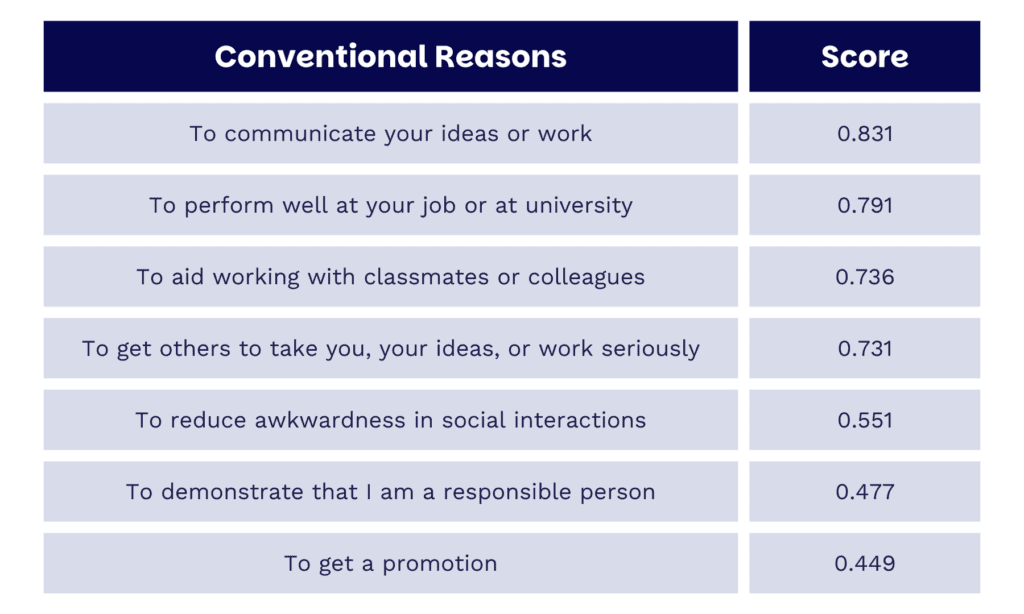
The motivations for camouflaging include fitting in and increasing connections with others, but the consequences of camouflaging include:
- exhaustion
- propagating stereotypes
- threats to self-perception
The most effective solution for reducing the need for autistic people to camouflage is to raise awareness to non-autistic people of different neurodiverse behaviours and thinking patterns.
- Reassess your interview process
An Autistic person might not be accustomed to demonstrating their strengths and skill sets during a ‘traditional’ job interview. When interviewing autistic candidates, you could:
- Leave a pause for time to answer as they process questions – start with a 5 second pause and work from there
- Be aware of over-sensory and under-sensory reactions
- Be clear and literal with instructions
- Make sure that you give specific instructions
- Allow for more time and support
Rather than traditionally interviewing autistic candidates, run a series of assessments or participation in a group project to gain an understanding of the person’s skills and fit. This could include:
Setting a ‘trial job’ rather than an interview: This could be a 20-minute duration or a few sessions over a week. It can mitigate coached answers and give the candidate a chance to trial the actual job, whilst also reducing the risk of discrimination.
Other methods to consider include:
- Providing alternatives to telephone screening, psychometric testing, gamification, pre-recorded interviews or assessment centers.
- Providing the interview questions two or three days in advance
- Advance provision of the structure of the interview with clear visual information
- Providing sensory neutral environments
If the candidate is unsuccessful, you should provide honest, specific, direct and clear written feedback.
- Tailor your onboarding process
Your HR processes can be tailored towards autistic employees. To do this effectively, you can utilise an expert in this field to customise the process successfully. Putting a support group in place who provide mentorship to the new employee regarding things such as dress code, roles, expectations and social norms, will help the transition.
When onboarding autistic employees:
- Be structured: one-pagers to introduce the team, for example, would be useful
- Be aware: things such as workplace social rules can be hard to understand for autistic people; not everything is necessarily clear and understood
- Be clear and literal: provide updates on projects well in advance, provide concise feedback and be clear about processes and instructions
- Allocate time: allow processing time, schedule catch ups and allow more time for the provision of support
- Minimise distractions: ensure that they are taking time away from instant messages to focus on tasks
- Use indicators and priorities: use these as visuals cues on desks and provide written instructions wherever possible
- Have a dedicated contact person: try to keep this consistent and avoid switching team members often
7: Understand individual triggers
A melt-down or shut-down can be experienced by an autistic person due to high stress levels. This can be triggered by a situation, an accumulation of stressful events e.g. sensory issues, over a period of hours, days, or weeks.
Meltdown and shutdown triggers could include:
- Too many demands placed on the autistic person
- Unexpected changes in plans or routines
- Sensory overload
- Social overload — Being exposed to too much social interaction (particularly relevant to shutdown)
- Overload can also stem from, or can be exacerbated by, internal triggers:
- Feeling shame or guilt
- Feeling inadequate
- Feeling like there is an injustice.
(Source: Embrace Autism)
Questions you could ask to recognise and try to prevent a melt-down or shut-down could be:
- How do I know when shutdowns are imminent?
- What’s the best way to support you when I notice that this is happening?
Providing Further Support
Having an Autistic colleague can be an enriching experience for managers and employees, but it may also present some challenges.
Many autistic people have a variety of sometimes exceptional skills that enable them to thrive in technology roles, ranging from Computer Programmers and Data Analysts to AI Engineers – just to name a few. Many can work full shifts on repetitive cloud security tasks without losing interest. Others have a high capacity for logical reasoning and pattern recognition, enabling them to systematically develop and test AI models.
But many autistic people are often disadvantaged when it comes to getting and retaining a job because of difficulties with social communication and interaction, other people’s lack of understanding, and sensory issues.
Putting our tips into practice in your organisation should help to avoid or overcome these to ensure enjoyable and effective working relationships.
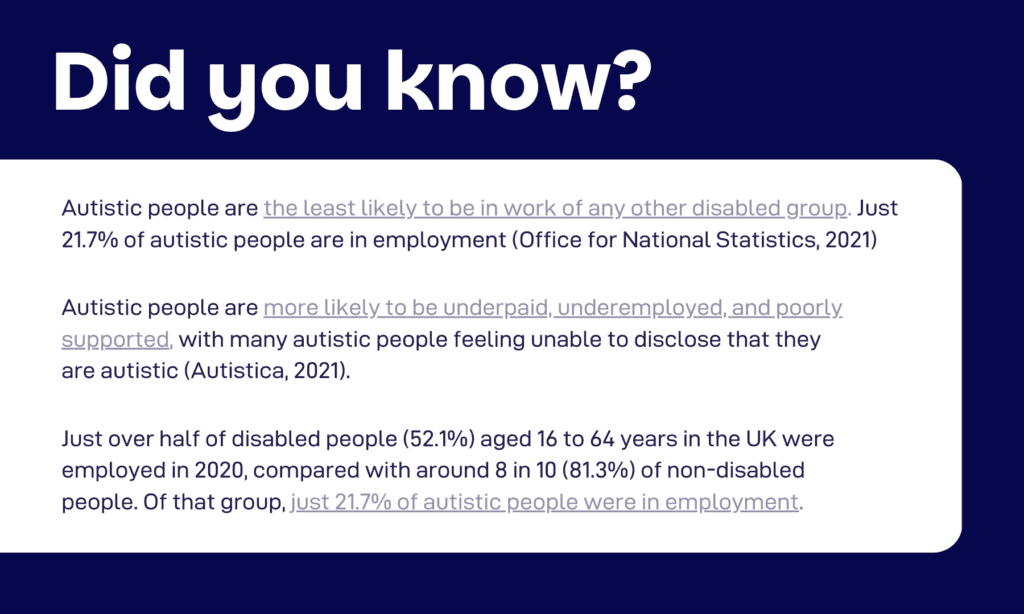
“Just over half of disabled people (52.1%) aged 16 to 64 years in the UK were employed in 2020, compared to around 8 in 10 (81.3%) of non-disabled people. Of that group, just 21.7% of autistic people were in employment.”